TL;DR:
- UK cosmetic surgeons require specialist certification for procedure-specific expertise and safety.
- Non-certified surgeons have higher complication rates and increased legal risks.
- Patients should verify credentials through GMC, BAAPS, BAPRAS, and ask key qualification questions.
Not every cosmetic surgeon in the UK is equally qualified, and that gap can cost you far more than money. Any GMC-registered doctor can legally perform cosmetic surgery in the UK private sector without specialist training, which means patients face real risks when they assume a title alone guarantees expertise.
Board certification is the single most reliable indicator that your surgeon has undergone rigorous, procedure-specific training and is held to strict professional standards. This guide explains what certification actually means in the UK, why it matters more than most people realise, how to verify it, and what else to check before you commit to any procedure.
Key Takeaways
| Point | Details |
|---|---|
| Certification ensures quality | Board certification verifies a surgeon has specialised training and upholds top standards. |
| Non-specialists increase risks | Choosing a surgeon without proper certification raises the chance of complications and poor outcomes. |
| Patients must verify credentials | Always check your surgeon’s board certification and ask about their specific experience before any procedure. |
| Regulation gaps exist | UK regulations let many non-specialists practise, so informed choices are crucial for safety. |
Why board certification matters in UK cosmetic surgery
Many people believe that any doctor performing cosmetic surgery must hold specialist qualifications. The reality is quite different. In the UK, GMC registration confirms only that a doctor is licensed to practise medicine. It says nothing about whether they have completed advanced surgical training, passed specialist examinations, or been assessed in the specific procedures they offer.
Board certification, by contrast, is awarded by bodies such as the Royal College of Surgeons (RCS) and the British Association of Plastic, Reconstructive and Aesthetic Surgeons (BAAPS). These organisations require surgeons to complete years of supervised specialist training, pass rigorous assessments, and maintain ongoing professional development. That is a fundamentally different standard from simply holding a medical licence.
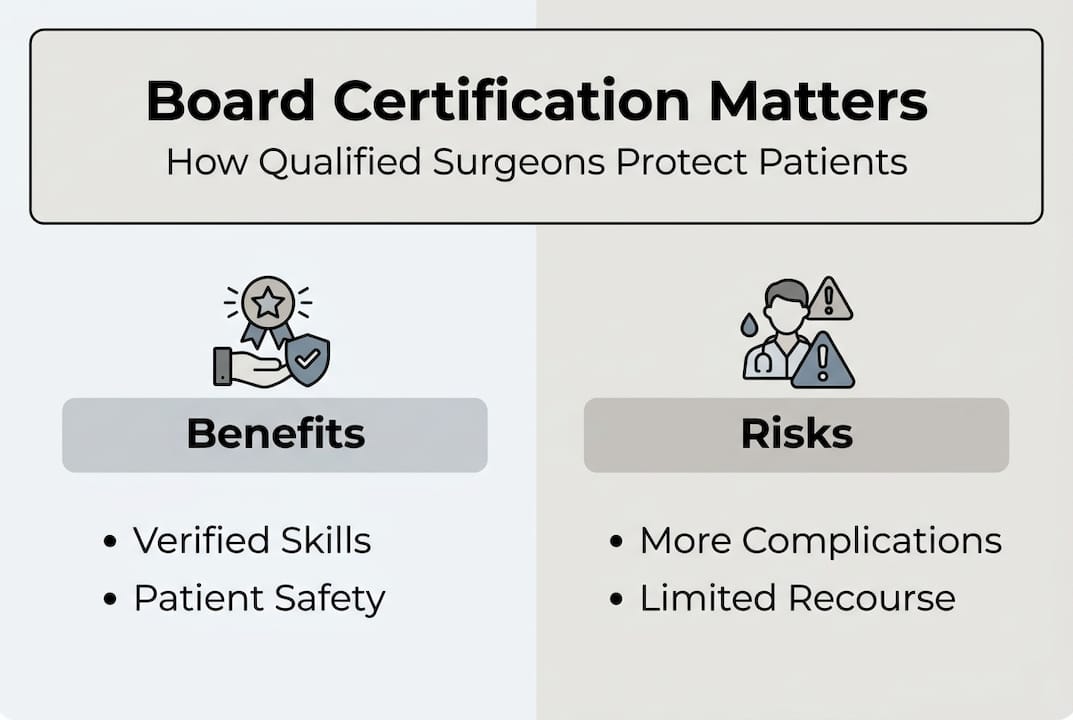
When a surgeon lacks this specialist accreditation, the consequences can be serious. Poorly performed procedures, inadequate aftercare planning, and failure to recognise complications are all more common among non-specialists. Reviewing safety standards for plastic surgery before your consultation helps you understand what a properly qualified surgeon should offer.
Key differences between GMC registration and board certification:
- GMC registration: confirms basic medical licence only
- RCS or BAAPS membership: confirms specialist surgical training
- Board certification: demonstrates procedure-specific competency and ongoing assessment
- Specialist register listing: confirms a surgeon has completed an approved training programme
| Qualification | What it confirms | Risk level if absent |
|---|---|---|
| GMC registration | Licensed to practise medicine | No specialist skill guaranteed |
| RCS Fellowship | Completed surgical training | Moderate to high risk |
| BAAPS membership | Specialist in plastic surgery | Higher complication likelihood |
| Specialist register | Approved training pathway | Significant risk of poor outcomes |
Reading about board-certified professionals gives you a clearer picture of what genuine expertise looks like in practice.
Pro Tip: During any initial consultation, ask directly: “Are you on the GMC specialist register for plastic surgery, and are you a member of BAAPS or BAPRAS?” A qualified surgeon will answer this without hesitation.
Risks of non-board-certified surgeons and supporting evidence
The stakes here are not abstract. Real data from comparable healthcare systems illustrates the danger clearly. US research published in Plastic and Reconstructive Surgery found that non-board-certified cosmetic surgeons faced punitive actions at a rate of 9%, compared to just 3 to 4% for board-certified plastic surgeons. That is more than double the rate, and it reflects a pattern that UK regulators and patient safety advocates have repeatedly flagged as a concern in the private sector here.
“Non-board-certified cosmetic surgeons face punitive action rates of 9%, more than twice the rate seen in board-certified plastic surgeons.” Plastic and Reconstructive Surgery, 2022.
The three most common complications associated with non-certified surgeons are:
- Infection and wound breakdown caused by poor surgical technique or inadequate sterile protocols
- Asymmetry and disfigurement resulting from insufficient anatomical knowledge and procedural experience
- Delayed or absent aftercare where patients are left without proper follow-up or complication management
These are not rare edge cases. They represent a predictable pattern when procedures are performed outside the boundaries of specialist training. Booking safe surgeon consultations with accredited professionals significantly reduces your exposure to these risks.
The UK regulatory environment makes this particularly urgent. Unlike some countries where specialist certification is legally required before performing cosmetic surgery, the UK private sector currently allows non-specialists to operate. This means the responsibility falls largely on you as a patient to verify credentials before proceeding. Understanding how to go about choosing the right plastic surgeon is therefore not just helpful; it is essential for your safety.
The financial dimension also matters. Patients who experience complications from non-certified surgeons often face costly corrective procedures, longer recovery periods, and in some cases, permanent changes that require ongoing medical management. The short-term saving from choosing a cheaper, less-qualified provider frequently becomes a far greater long-term expense.
Expert nuance: beyond certification, what to check in your surgeon
Board certification is your baseline, not your finish line. Even among fully certified plastic surgeons, there are meaningful differences in procedure-specific experience, communication style, and aftercare provision. A surgeon who is excellent at rhinoplasty may have limited experience with body contouring. Certification alone does not tell you that.
NHS guidance is clear on this point: even among specialists, you should verify procedure-specific experience by asking about complication rates and the aftercare support provided. This is not an awkward question. It is a reasonable expectation, and any reputable surgeon will welcome it.
Five key questions to ask during your consultation:
- How many times have you performed this specific procedure, and what are your complication rates?
- What does your aftercare programme include, and who do I contact if I have concerns?
- Can you show me before-and-after photographs of patients with a similar anatomy to mine?
- Are you covered by appropriate medical indemnity insurance for this procedure?
- What would you do differently if the outcome does not meet expectations?
For those exploring options with top London surgeons, these questions are especially relevant given the volume of providers in the capital. Similarly, if you are assessing best surgery standards more broadly, knowing what to ask separates excellent care from average care.
Pro Tip: Never choose a surgeon primarily based on price or location. A lower fee often reflects less experience, fewer qualifications, or reduced aftercare provision. The cost of corrective surgery is almost always higher than the original procedure.
If you are also considering skin or scar-related treatments alongside a surgical procedure, reviewing skin scar treatment advice from a specialist perspective will help you ask the right questions about post-surgical skin management.
How to verify certification and protect yourself
Knowing what to look for is one thing. Knowing how to confirm it is another. The good news is that verification is straightforward when you know the steps. UK Parliamentary recommendations have called for greater transparency in surgeon credentials, and several reliable tools are already available to patients right now.
Here is a practical step-by-step process:
- Check the GMC specialist register. Visit the GMC website and search your surgeon’s name. Confirm they are listed under “plastic surgery” as a specialty, not just as a general practitioner.
- Verify BAAPS or BAPRAS membership. Both organisations maintain publicly searchable membership directories. Full membership requires specialist training and ongoing peer review.
- Ask for credentials directly. During your consultation, request written confirmation of qualifications and ask which professional bodies they belong to.
- Look for Care Quality Commission (CQC) registration. The clinic itself should be CQC-registered if it operates in England. This confirms minimum safety and governance standards.
- Research their published work or awards. Surgeons who contribute to professional education, research, or peer-reviewed publications demonstrate a deeper commitment to their field.
Be cautious of titles like “cosmetic surgeon” or “aesthetic surgeon” without accompanying specialist register confirmation. These titles are not legally protected in the UK, which means any GMC-registered doctor can use them regardless of training level.
For those exploring Manchester surgery options or comparing providers across regions, using alternative verification platforms can help you cross-reference credentials and patient reviews independently.
Pro Tip: Seek surgeons who actively encourage questions and offer transparent, written information about their qualifications. Reluctance to share credentials is a warning sign, not a minor concern.
The uncomfortable truth about UK cosmetic surgery regulation
Here is something the industry does not always say plainly: the UK’s regulatory framework for cosmetic surgery is not fit for purpose. Official bodies including the Royal College of Surgeons and Parliamentary committees have pushed for mandatory specialist certification before any surgeon can perform cosmetic procedures. Yet meaningful legislative change has been slow, in part because some industry voices fear that tighter rules will reduce the pool of practitioners and limit commercial activity.
That is a troubling priority. Patient safety should never be weighed against commercial convenience. The gap between what is legally permitted and what is genuinely safe is where most cosmetic surgery harm occurs.
Until the law catches up, the burden sits with you. Choosing certified professionals with verified specialist credentials, asking the right questions, and refusing to prioritise price over qualifications are the most powerful protections available to you right now. The regulatory environment may be imperfect, but your decision-making does not have to be.
Take the next step with expert care
Understanding the risks of unregulated practice is the first step. Choosing a surgeon who meets the highest standards is the next.

At Lux Plastic Surgery, every procedure is performed by Professor Sandip Hindocha, an award-winning consultant with full specialist accreditation and extensive procedure-specific experience. Whether you are just beginning your research or ready to book, our resources on choosing the right plastic surgeon and plastic surgery basics give you the knowledge to make a confident, informed decision. We also provide thorough guidance on recovery tips so you know what to expect at every stage. Book a consultation with us and experience the difference that genuine expertise makes.
Frequently asked questions
What is a board-certified plastic surgeon in the UK?
A board-certified plastic surgeon in the UK is a specialist recognised by bodies such as the Royal College of Surgeons, with advanced training and accreditation in plastic and cosmetic procedures. This goes well beyond basic GMC registration and involves years of supervised specialist training.
Can any doctor perform cosmetic surgery in the UK?
Yes, any GMC-registered doctor can legally perform cosmetic surgery in the UK private sector, but the absence of specialist training significantly increases the risk of complications and poor outcomes.
How can I check if my surgeon is board-certified?
You can verify board certification by checking the GMC specialist register, confirming membership with organisations like BAAPS or BAPRAS, and asking for written confirmation of credentials during your consultation.
Are board-certified surgeons safer?
Yes. US data shows that non-board-certified cosmetic surgeons face punitive actions at more than twice the rate of board-certified plastic surgeons, reflecting meaningfully better safety and outcomes among accredited specialists.