Medically reviewed by Professor Sandip Hindocha, GMC-registered Consultant Plastic Surgeon and NHS Clinical Director. Articles are reviewed against current UK guidance from the GMC, BAAPS, BAPRAS and NICE.
TL;DR:
- Plastic surgery includes reconstructive procedures restoring function and appearance, alongside elective cosmetic enhancements.
- Choosing a qualified UK surgeon registered with GMC and professional bodies ensures safety and optimal results.
- All procedures carry risks and recovery times; thorough planning and honest discussions are essential.
Plastic surgery is frequently misunderstood as a purely vanity-driven choice. In reality, it encompasses a broad spectrum of procedures that restore function after illness or injury, rebuild confidence following major life changes, and yes, refine appearance for those who simply want to feel more like themselves. Many people in the UK feel uncertain about which procedures fall under which category, how to choose a qualified surgeon, and what genuine recovery looks like. This guide cuts through the confusion, giving you clear, practical information about the types of procedures available, how to select your provider wisely, and what to realistically expect before, during, and after surgery.
Key Takeaways
| Point | Details |
|---|---|
| Two main surgery types | Plastic surgery in the UK covers both reconstructive and cosmetic (aesthetic) procedures, each with their own purposes. |
| Personalisation is essential | Results and safety are maximised when procedures are tailored to your individual anatomy and goals in collabouration with a certified surgeon. |
| Safety and recovery matter most | Checking surgeon credentials, clinic regulation, and understanding the potential risks and recovery process can help you achieve the best possible outcome. |
| UK trends shape choices | Breast, body, and facial surgeries remain most popular—with newer trends and rising demand among both women and men. |
What is plastic surgery? Defining reconstructive and cosmetic procedures
The word “plastic” in plastic surgery has nothing to do with synthetic materials. It derives from the Greek word plastikos, meaning to mould or shape. This distinction matters because it frames the discipline correctly: plastic surgery is fundamentally about reshaping tissue to improve either function, appearance, or both.
As defined by specialist medical sources, plastic surgery is a surgical specialty involving the restoration, reconstruction, or alteration of the human body. It includes two main categories: reconstructive surgery, which focuses on restoring function and appearance after injury, illness, or congenital defects, and cosmetic (aesthetic) surgery, which aims to improve physical appearance. Understanding this dual purpose changes how most people think about the field entirely.
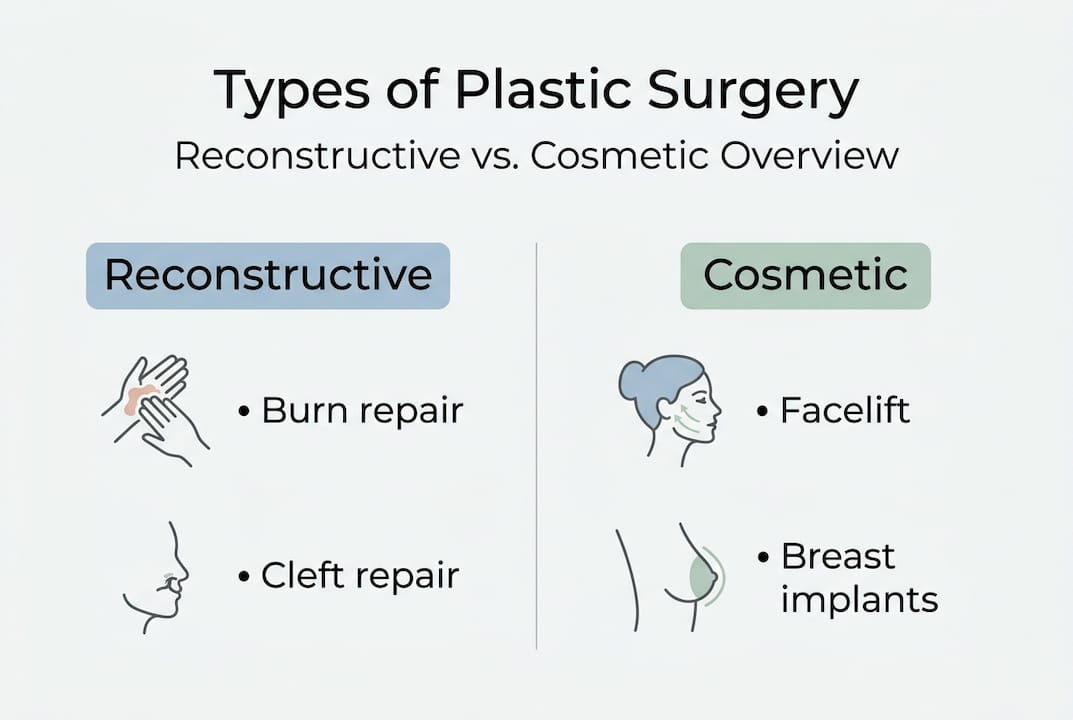
Reconstructive surgery addresses conditions that arise from trauma, cancer treatment, congenital differences, or severe burns. A person who has undergone a mastectomy may choose breast reconstruction. A child born with a cleft lip requires reconstructive work to restore normal function and appearance. Someone who sustained severe facial burns may need multiple reconstructive procedures over several years.
Cosmetic surgery, on the other hand, is elective. It is chosen by individuals who are medically healthy but wish to alter or refine an aspect of their appearance. Common motivations include correcting a feature that has caused long-term self-consciousness, addressing physical changes following weight loss or pregnancy, or simply wanting to look more in line with how one feels internally.
| Type | Primary goal | Examples |
|---|---|---|
| Reconstructive | Restore function and form | Burn repair, cleft repair, post-mastectomy breast reconstruction, scar revision |
| Cosmetic (aesthetic) | Improve appearance | Rhinoplasty, breast augmentation, blepharoplasty, facelift |
Both categories can genuinely improve quality of life. It would be overly simplistic to suggest that cosmetic procedures are frivolous while reconstructive ones are serious. Confidence, self-image, and mental wellbeing are real and important outcomes. For a fuller breakdown of types of plastic surgery, including the nuances across sub-specialities, it helps to review detailed procedure categories before attending any consultation.
What unites both categories is the requirement for skilled surgical planning, careful patient assessment, and realistic expectation management. A surgeon working in either discipline must understand anatomy deeply, account for individual variation, and anticipate how tissue will heal over time.
Popular plastic surgery procedures in the UK: Face, breast, and body
With the basics covered, let’s break down what real procedures involve and which options are most in demand across the UK.
Common facial procedures include rhinoplasty (nose reshaping), blepharoplasty (eyelid surgery), facelift, and otoplasty (ear correction). Each targets a specific anatomical concern, and each requires an individualised approach based on the patient’s facial structure, skin quality, and desired outcome.
Rhinoplasty is one of the most technically complex facial procedures. Surgeons reshape the nasal bones and cartilage to change the size, angle, or symmetry of the nose. Recovery typically involves swelling for several months before the final shape settles. Blepharoplasty removes or repositions excess skin and fat around the eyelids, and is popular for addressing drooping upper lids or puffy lower lids that create a tired appearance. A facelift (rhytidectomy) lifts and tightens facial and neck tissue to address sagging, jowls, and deep folds, producing more natural results than non-surgical alternatives for significant laxity.
On the breast side, augmentation remains the most frequently performed cosmetic procedure in the UK, typically using implants or fat transfer. Breast reduction addresses physical discomfort from disproportionately large breasts, including back pain, skin irritation, and posture problems. It is one of the few aesthetic procedures that often has clear functional benefits alongside cosmetic improvement. Mastopexy (breast lift) reshapes and repositions breast tissue without changing the overall volume significantly.
For the body, body contouring procedures such as liposuction and abdominoplasty (tummy tuck) are consistently popular. Abdominoplasty can be full or mini, and is often combined with liposuction for optimised results. It is particularly effective for patients with loose skin and separated abdominal muscles following pregnancy or significant weight loss. Post-weight loss procedures are a growing area, as more people reach their target weight and want to address residual skin laxity that exercise cannot resolve.
According to the 2024 BAAPS audit, UK BAAPS members performed 27,462 cosmetic procedures, a 5% rise on the previous year. Women make up the majority of surgical patients, though male interest continues to grow, particularly in gynecomastia (male breast reduction), rhinoplasty, and eyelid surgery.
| Procedure | Category | Notes |
|---|---|---|
| Breast augmentation | Breast | Most performed overall |
| Rhinoplasty | Face | Complex; long recovery for final result |
| Blepharoplasty | Face | Popular among 50+ age group |
| Abdominoplasty | Body | Often combined with liposuction |
| Liposuction | Body | Contouring, not a weight-loss method |
| Breast reduction | Breast | Functional and cosmetic benefits |
For a broader view of body contouring trends in the UK, including newer techniques and growing demand areas, it’s worth exploring how the landscape is evolving this year.
Pro Tip: When attending your consultation, discuss not only your desired result but also your lifestyle. Factors like smoking, regular exercise habits, and planned future pregnancies all affect which procedure is most appropriate and when you should have it.
How to choose the right procedure and surgeon
Armed with a sense of the most common procedures, it’s time to consider how you can actively safeguard your experience and choose your provider wisely.
The single most important decision in your plastic surgery journey is who performs the procedure. An excellent surgeon working in an appropriate facility dramatically reduces risk and improves the likelihood of a result you’ll be happy with long-term.
Here is a clear, step-by-step process for selecting a plastic surgeon in the UK:
- Verify GMC registration. Every surgeon working in the UK must be registered with the General Medical Council. For plastic surgery, they should appear on the Specialist Register, not simply hold a general medical licence.
- Check professional body membership. GMC-registered surgeons on the specialist register, members of BAAPS/BAPRAS, and clinics with CQC registration offer the strongest professional safeguards available in the UK.
- Confirm CQC registration for the clinic. The Care Quality Commission regulates healthcare providers in England. Any clinic where surgery is performed should hold current CQC registration.
- Request evidence of relevant experience. Ask how many times the surgeon has performed your specific procedure. A facelift specialist and a rhinoplasty specialist are not interchangeable.
- Attend a proper consultation. A credible surgeon will assess your anatomy, discuss your goals honestly, explain risks, and potentially suggest alternative approaches. They will not pressure you or promise unrealistic outcomes.
- Take time to decide. Ethical practices build in a cooling-off period. Walk away from any clinic that pressures immediate booking or offers heavily discounted “today only” pricing.
Learning how to select procedures safely is a skill in itself, and one that genuinely pays off when it comes to your health and final result. For further reading on credential checks and what expert consultations should involve, detailed guidance is available to help you ask the right questions from the outset.
Understanding safety and surgeon selection in the UK context is particularly important given the volume of unregulated aesthetic providers operating in the market today.
“Credentials matter more than marketing. A surgeon’s professional qualifications, specialist register listing, and professional body membership are the clearest indicators of safe, competent care.”
Pro Tip: Do not let social media “before and after” images or pricing drive your decision. Images can be selectively curated, and a lower price often reflects shortcuts in safety, anaesthetic provision, or follow-up care that you will not appreciate until something goes wrong.
Understanding risks, recovery, and the reality of results
Even with the best preparation, understanding the risks and what recovery really involves will put you one step ahead.
Every surgical procedure carries risk. This is not a reason to avoid plastic surgery, but it is a reason to go in with clear eyes and thorough preparation. The more honestly you discuss your health history, goals, and concerns with your surgeon, the better placed they are to minimise risk and set realistic expectations.
Common risks associated with plastic surgery include:
- Scarring — all surgery creates scars; skilled surgeons minimise and position them strategically, but they do not disappear entirely
- Infection — managed with antibiotics and sterile technique, but still a possibility, particularly in the early healing phase
- Haematoma — a collection of blood under the skin that may require drainage
- Necrosis — tissue death, more common in smokers or those with circulation problems
- Capsular contracture — specific to implants; occurs when scar tissue tightens around an implant
- Altered sensation — numbness or heightened sensitivity, which often resolves over months
- Blood clots (DVT/PE) — deep vein thrombosis and pulmonary embolism are serious but preventable risks, addressed through compression garments and early mobilisation
- Asymmetry — no two sides of the body are identical; minor asymmetry can occur and may require revision
- Revision surgery — a proportion of patients require a second procedure to refine the initial result
As NHS guidance confirms, risks include scarring, infection, haematoma, necrosis, capsular contracture, altered sensation, blood clots, asymmetry, and the need for revision surgery, with wound issues worsening scarring outcomes. It is crucial to factor these possibilities into your decision, not to cause alarm, but to ensure you are making a genuinely informed choice.
Recovery timelines vary by procedure. For body and breast surgery, expect 2 to 6 weeks of primary recovery, during which driving is typically restricted for the first one to two weeks, help at home is necessary, and swelling settles progressively over three months. Full fatigue can persist for up to three months after major body procedures.
Understanding the benefits and risks side by side is essential before committing to any procedure. Exploring the full landscape of risks and options will help you frame expectations accurately during your consultation.
“Results are not immediate. Swelling, bruising, and tightness are part of healing, not signs that something is wrong. Final outcomes often take six to twelve months to fully reveal themselves.”
Pro Tip: Before your procedure, plan your time off work, arrange home help for at least the first week, prepare easy meals, set up a comfortable recovery space, and confirm with your surgeon exactly when follow-up appointments will occur. Practical preparation significantly reduces stress during recovery.
Our perspective: What most plastic surgery guides don’t tell you
Most articles about plastic surgery focus on what procedures exist and what they cost. Very few address the more nuanced reality that the quality of your result has less to do with which procedure you choose and far more to do with how thoroughly it is personalised to your anatomy, your goals, and your lifestyle.
We see this repeatedly. Patients who arrive with a specific photograph from social media requesting a replica of someone else’s outcome are often those who end up dissatisfied, not because the surgery was poorly performed, but because it was not designed for their unique body. The best results emerge from a genuine dialogue between patient and surgeon, one where anatomy is assessed honestly and goals are shaped by what is actually achievable.
Rising trends in facial rejuvenation and body contouring reflect genuine anti-ageing and post-weight loss needs, with men increasingly accounting for facelift procedures (up 26%). Yet complications remain notably higher among patients who seek unregulated providers or travel abroad for cheaper procedures, placing additional strain on NHS resources when things go wrong.
The opportunity to evaluate options safely through a regulated, experienced specialist is the single most important step you can take. Regulated care, transparent pricing, and honest consultation are not luxuries in this field. They are the standard that protects your health and your outcome.
Considering plastic surgery? Take your next step with confidence
At Lux Plastic Surgery, Professor Sandip Hindocha and his team offer personalised consultations across Bedford, London, and Manchester, where your goals, anatomy, and health are assessed together to identify the most appropriate pathway for you.

Choosing a UK-registered specialist with professional body accreditation means you benefit from regulated care, proper informed consent processes, and structured follow-up. Whether you are exploring body contouring options, ready to explore procedure options in detail, or want to better understand the health and confidence benefits associated with specific procedures, the right starting point is always a thorough, unhurried consultation with a qualified specialist. Book yours today and take the first step with clarity and confidence.
FAQ
Is plastic surgery covered by the NHS in the UK?
The NHS only covers plastic surgery for specific medical reasons, such as significant psychological distress or functional problems; most cosmetic procedures are privately funded and must be arranged through private clinics.
What should I look for in a plastic surgeon?
Ensure your surgeon is GMC-registered and listed on the specialist register, ideally holds BAAPS or BAPRAS membership, and that their clinic is CQC-registered for regulated surgical care.
What are the most common risks after plastic surgery?
Risks include scarring, infection, haematoma, necrosis, altered sensation, blood clots, asymmetry, and in some cases the need for revision surgery, all of which should be discussed thoroughly before proceeding.
How long does recovery from plastic surgery typically take?
Most patients undergoing breast or body procedures need 2 to 6 weeks to recover from the primary procedure, with swelling continuing to settle over three months before final results are visible.
Is plastic surgery suitable for everyone?
Surgery may not be advisable for those with certain health conditions or future pregnancy plans, making a thorough pre-operative consultation with a qualified surgeon essential for identifying the right timing and approach for you.