Medically reviewed by Professor Sandip Hindocha, GMC-registered Consultant Plastic Surgeon and NHS Clinical Director. Articles are reviewed against current UK guidance from the GMC, BAAPS, BAPRAS and NICE.
TL;DR:
- A tummy tuck, or abdominoplasty, removes excess skin, fat, and repairs weakened muscles to reshape the abdomen, not for weight loss. It is suitable for individuals post-pregnancy or significant weight loss with persistent laxity, but not as a primary weight reduction method. Recovery spans several weeks, with long-lasting structural results that can be affected by pregnancy, weight changes, or ageing.
A tummy tuck is one of the most misunderstood procedures in cosmetic surgery. Many people assume it is a shortcut to weight loss, but what is a tummy tuck, really? Medically known as abdominoplasty, it is a surgical procedure designed to remove excess skin, eliminate stubborn fat deposits, and repair weakened abdominal muscles. It reshapes and firms the abdomen in ways that diet and exercise simply cannot address. This guide covers what the procedure involves, who it suits, how it compares to alternatives, and what recovery genuinely looks like.
Key takeaways
| Point | Details |
|---|---|
| Not a weight loss tool | A tummy tuck contours the abdomen and repairs muscles; it does not replace diet or exercise. |
| Muscle repair is central | Surgeons repair separated abdominal muscles (rectus diastasis) for both functional and aesthetic improvement. |
| Candidacy requires stable weight | Patients should be at a healthy, stable weight before surgery to achieve the best results. |
| Recovery takes several weeks | Expect swelling, restricted activity, and gradual healing over six to twelve weeks post-surgery. |
| Results can last a lifetime | Structural changes are permanent, but future pregnancies or significant weight changes can affect outcomes. |
What a tummy tuck procedure involves
A tummy tuck, or abdominoplasty, removes excess skin and fat while repairing weakened or separated abdominal muscles to produce a firmer, flatter abdomen. This is not simply cosmetic tidying. For many patients, particularly those who have been through pregnancy or major weight loss, the structural changes are genuinely meaningful.
The surgical steps
The procedure typically follows a clear sequence. A horizontal incision is made between the pubic hairline and the belly button, with the length depending on how much excess skin needs removing. The surgeon then lifts the skin to access the abdominal wall underneath.
One of the most significant steps is the repair of rectus diastasis, the separation of the two central abdominal muscles that commonly occurs during pregnancy. Plastic surgeons combine rectus fascia plication with excess tissue excision to maximise contour improvement and restore core function. This muscle repair distinguishes a tummy tuck from liposuction or any non-surgical treatment.
Once muscle repair is complete, excess skin is removed, and the remaining skin is pulled downward and sutured into position. Liposuction is frequently used alongside the procedure to refine flanks and surrounding areas, creating a smoother overall contour.
Types of tummy tuck
Not every tummy tuck is the same. The procedure you need depends on the degree of skin laxity, fat distribution, and muscle separation you have:
- Mini tummy tuck: Addresses the lower abdomen only, with a shorter incision and no repositioning of the belly button. Suitable for patients with mild skin laxity below the navel.
- Full tummy tuck: The most common form. Treats the entire abdominal area from the pubic region to below the ribs, with belly button repositioning.
- Extended abdominoplasty: Goes beyond the abdomen to address excess skin on the flanks and lower back. Often chosen by patients following significant weight loss.
Modern techniques have substantially improved outcomes. The SHARP method tightens abdominal fascia in multiple directions, addressing the multi-directional nature of abdominal expansion during pregnancy or weight gain. Scar placement is deliberately kept low and discreet, and belly button repositioning aims for a natural appearance rather than a surgically obvious one.
Pro Tip: Ask your surgeon specifically about scar placement during your consultation. A well-placed incision should sit below the bikini line, making it easily concealable under underwear or swimwear.
Who is suitable for a tummy tuck?
The tummy tuck procedure works best for a specific group of patients. Understanding whether you are a suitable candidate is arguably the most important step before pursuing surgery.
Typical candidates include:
- Post-pregnancy patients who have experienced skin stretching, muscle separation, or persistent abdominal laxity that has not responded to exercise.
- People following significant weight loss, whether through lifestyle change or bariatric surgery, who are left with excess skin that hangs or folds uncomfortably.
- Individuals with good skin quality but who have developed muscle separation or lower abdominal pouching that cannot be addressed through non-surgical means.
There are also clear factors that affect candidacy. A tummy tuck is not a weight loss procedure; patients with high visceral fat are advised that aesthetic improvement will be limited, and risks increase. You should be at a stable, healthy weight for at least six months before surgery. Smoking significantly impairs healing and increases complication risk, and most surgeons require patients to quit well in advance.
Women who are planning future pregnancies are generally advised to delay surgery. Pregnancy after a tummy tuck can undo the muscle repair and require revision work. Similarly, patients with unmanaged health conditions such as diabetes or cardiovascular disease need medical clearance before proceeding.
The evaluation also considers skin elasticity, the degree of muscle separation, and the extent of abdominal laxity. A thorough consultation with a qualified surgeon will assess these factors and help set realistic expectations. You can explore body contouring suitability for a broader view of candidacy across procedures.
Tummy tuck vs other body contouring options
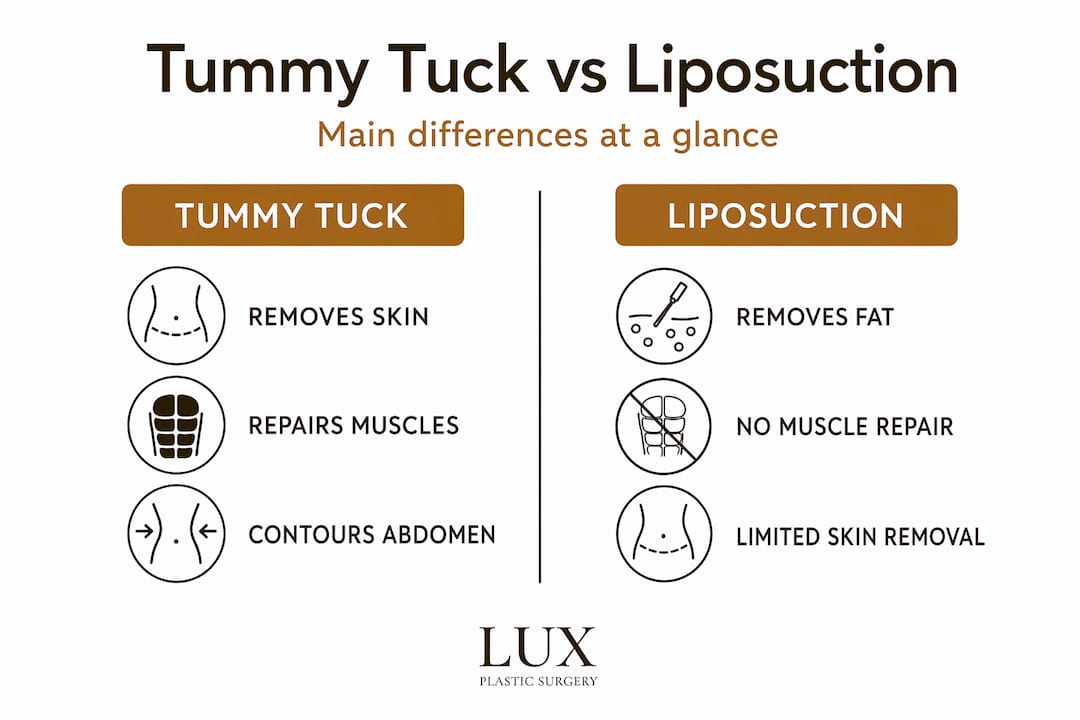
Understanding how a tummy tuck compares to other procedures helps you make an informed decision. The most common point of confusion is the difference between a tummy tuck and liposuction.
Liposuction removes fat deposits but cannot address muscle separation or remove excess skin. A tummy tuck, by contrast, corrects all three issues: excess fat (often with liposuction combined), loose skin, and weakened muscles. If your concern is primarily excess skin and muscle laxity rather than isolated fat pockets, liposuction alone will not deliver the result you are looking for.
| Procedure | What it addresses | Suitable for | Limitations |
|---|---|---|---|
| Full tummy tuck | Skin, muscle separation, fat | Post-pregnancy, post-weight loss | Surgical recovery, scarring |
| Mini tummy tuck | Lower skin laxity only | Mild lower abdominal laxity | Limited scope |
| Liposuction | Localised fat only | Good skin elasticity, no muscle separation | Cannot remove skin or repair muscle |
| Non-surgical options | Surface tightening, mild fat reduction | Minimal laxity, no muscle separation | Limited results on significant laxity |
| Extended abdominoplasty | Abdomen, flanks, lower back | Major weight loss patients | Longer recovery, larger scar |
For patients with good skin quality and less excess tissue, endoscopic lipoabdominoplasty offers a minimally invasive alternative. Some patients also benefit from combining a tummy tuck with fat transfer procedures to restore volume to areas affected by skin removal.
Post-weight loss body contouring frequently involves a full or extended tummy tuck as the centrepiece of a broader surgical plan. In these cases, the tummy tuck is often staged alongside other procedures depending on the patient’s health and goals.
Pro Tip: If you are considering multiple procedures, discuss the sequencing carefully with your surgeon. Combining certain operations can reduce total recovery time, but patient safety always determines what is performed together.
Risks, benefits, and recovery after a tummy tuck
Understanding the recovery process and potential risks is just as important as understanding the procedure itself. Tummy tucks offer significant, lasting tummy tuck benefits, but they require a commitment to proper aftercare.
What to expect during recovery
Aftercare and medical follow-up are critical to achieving the best possible result. Here is a realistic timeline:
- Days 1 to 7: You will experience swelling, bruising, and discomfort. Drains may be in place to prevent fluid build-up. Rest is required, and movement is limited.
- Weeks 2 to 4: Swelling gradually reduces. Light walking is encouraged, but strenuous activity remains off limits. Compression garments are worn continuously.
- Weeks 4 to 6: Most patients return to desk-based work. Core exercises and heavy lifting remain restricted.
- Weeks 6 to 12: The majority of swelling resolves. Final contour results become visible. Exercise can typically resume with medical clearance.
Risks to be aware of
Like any surgical procedure, a tummy tuck carries risks. These include infection, seroma (fluid accumulation), blood clots, delayed wound healing, asymmetry, and changes in sensation. Choosing a highly experienced, GMC-registered surgeon significantly reduces the likelihood of serious complications. Scarring is inevitable, but with proper scar management, including silicone sheeting and sun protection, results improve considerably over time. For patients unhappy with existing scarring, scar revision surgery is a viable option.
Long-term tummy tuck benefits
Modern tummy tucks are increasingly viewed as restorative procedures, improving both function and psychological well-being beyond purely cosmetic outcomes. Patients frequently report improved posture, reduced back pain from core muscle repair, greater clothing confidence, and a more active lifestyle post-recovery.
When revision surgery may be needed
Structural tummy tuck results are permanent in terms of the muscle repair and skin removal performed. However, certain life events and physical changes can affect long-term outcomes.
Key reasons a revision tummy tuck may be considered include:
- Future pregnancies: Carrying a baby after a tummy tuck can re-stretch the muscles and skin, diminishing results and potentially requiring further surgery.
- Significant weight fluctuations: Gaining and losing large amounts of weight after surgery affects skin elasticity and can cause new areas of laxity.
- Ageing and skin changes: Over time, skin naturally loses elasticity. This can affect the surface appearance even when the underlying structural repair remains intact.
- Unsatisfactory scarring: Some patients seek revision specifically to improve the appearance of their scar, which can be addressed through targeted scar revision techniques.
Patient education before surgery is the best defence against disappointment after it. Surgeons who clearly explain the role of lifestyle maintenance in preserving results set their patients up for the best possible long-term experience.
My perspective on tummy tuck misconceptions
I’ve spent years looking at how patients approach this decision, and the same pattern comes up repeatedly. People arrive at their first consultation having researched the procedure extensively online, yet they still fundamentally misunderstand its purpose. They expect a tummy tuck to make them thinner. It does not. What it does is restore structure that weight loss and exercise cannot recover.
The advances in surgical technique genuinely impress me. Tightening the abdominal fascia vertically, horizontally, and obliquely addresses the full complexity of how the abdomen changes during pregnancy or weight gain. This is not a blunt procedure anymore. When performed by an experienced surgeon, it is precise and restorative.
What I always tell people: the result you maintain five years from now depends as much on you as it does on the surgeon. Stable weight, a healthy lifestyle, and realistic expectations about ageing are what separate patients who are thrilled long-term from those who want revision surgery after two years.
The emotional dimension matters too. Patients who have spent years covering their abdomen often describe the psychological shift after recovery as profound. That is not something to dismiss. It is a legitimate tummy tuck benefit that the procedure reliably delivers when patients are well-selected and well-informed.
— Gregg
How Luxplasticsurgery supports tummy tuck patients
If you are seriously considering a tummy tuck, the quality of your surgical team and the aftercare support you receive matters as much as the procedure itself. Luxplasticsurgery offers bespoke body contouring in Bedford performed by Professor Sandip Hindocha, an award-winning consultant with extensive experience in abdominoplasty and complex body contouring.

From your first consultation through to recovery, the focus is on personalised, safety-first care. Whether you are exploring a tummy tuck for the first time or comparing it to other procedures, you can find a thorough overview of plastic surgery options, benefits, and safety on the Luxplasticsurgery website. Book a consultation to discuss your goals with a surgeon who will give you an honest, informed assessment of what is right for you.
FAQ
What is a tummy tuck and what does it do?
A tummy tuck (abdominoplasty) removes excess skin and fat from the abdomen while repairing separated or weakened abdominal muscles, producing a firmer, flatter contour that exercise alone cannot achieve.
How long does tummy tuck recovery take?
Most patients return to light activity within four to six weeks, with full recovery and final results typically visible between six and twelve weeks after surgery.
Is a tummy tuck the same as liposuction?
No. Liposuction removes localised fat but cannot address excess skin or muscle separation. A tummy tuck treats all three, and often incorporates liposuction as part of the procedure for optimal contouring.
Who is a good candidate for a tummy tuck?
Ideal candidates are at a stable, healthy weight with excess abdominal skin, muscle separation, or persistent laxity following pregnancy or significant weight loss. It is not a weight loss procedure.
Can tummy tuck results be permanent?
The structural changes from muscle repair and skin removal are permanent, but future pregnancies, significant weight fluctuations, and natural ageing can affect the surface appearance and may require revision surgery.