Medically reviewed by Professor Sandip Hindocha, GMC-registered Consultant Plastic Surgeon and NHS Clinical Director. Articles are reviewed against current UK guidance from the GMC, BAAPS, BAPRAS and NICE.
TL;DR:
- Weight loss causes breasts to shrink, sag, and change shape, with outcomes varying based on age, genetics, and loss speed. Surgical options like implants, lifts, or combined procedures can restore volume and contour, but timing and safety are crucial for optimal results. Choosing an experienced surgeon and waiting for weight stability greatly reduce risks and improve natural-looking outcomes.
Losing a significant amount of weight is a real achievement, but the changes it brings to your breasts are rarely what you expected. Breasts after weight loss often look and feel dramatically different: smaller, flatter, or lower than before. The frustrating truth is that these changes are not uniform. Two women who lose the same amount of weight can end up with completely different outcomes based on their age, genetics, and how quickly the weight came off. This guide covers exactly what’s happening, what the latest UK surgical trends show, and which options genuinely work to restore your shape and confidence.
Key Takeaways
| Point | Details |
|---|---|
| Breasts often shrink with weight loss | Breast size usually decreases because fat tissue reduces, but results vary by individual composition and genetics. |
| Surgery options vary by concern | Implants add volume, lifts correct sagging, and combined procedures often give the best restoration after weight loss. |
| BMI impacts surgery safety | A BMI over 25.2 significantly raises postoperative complication risks, so patient health optimisation is essential. |
| Wait for weight stability | Stable body weight for at least six months before surgery improves results and reduces complications. |
| Choose expert surgeons | Selecting trained, regulated plastic surgeons ensures safer procedures and natural, personalised outcomes. |
How weight loss affects breast size and shape
Breasts are composed largely of adipose tissue (body fat), which means they are directly affected every time overall body fat decreases. Unlike muscle, you cannot target where your body draws fat from, so breasts frequently lose volume proportionally alongside the rest of your body. The result can be a deflated appearance, looser skin, or both.
Cup size drops are commonly seen after losing 10 to 15 per cent of body weight, though genetics and the ratio of fat to glandular tissue determine how pronounced the change actually is. Women with denser, more glandular breasts may notice less size reduction but still experience sagging. Women with a higher proportion of fatty tissue tend to see more dramatic volume loss.
Key factors that shape your post-weight loss breast appearance:
- Speed of weight loss: Rapid loss gives skin less time to adapt, increasing the likelihood of laxity.
- Age: Skin elasticity naturally declines with age, so older women are more likely to experience ptosis (drooping).
- Genetics: Skin quality and connective tissue strength are largely inherited.
- Starting cup size: Larger breasts carry more weight, making them more susceptible to sagging once volume decreases.
- Number of pregnancies: Previous pregnancies stretch breast skin and ligaments, compounding post-weight loss changes.
Ptosis is the clinical term for breast drooping, and it is graded on a scale based on how far the nipple has descended relative to the breast fold. Mild ptosis means the nipple sits just at the fold; severe ptosis means it points downward. Understanding your grade matters because it directly determines which surgical options are appropriate.
Pro Tip: Strength training will not reverse fat loss in your breasts, but building the pectoralis major muscle underneath can improve chest projection and create a subtle lift effect without surgery. Think of it as the scaffolding beneath the structure.
The body contouring trends in the UK increasingly reflect this reality: women are seeking procedures that address both volume and skin quality together, rather than simply adding size.

Current UK trends in breast surgery after weight loss
The UK cosmetic surgery landscape in 2025 and into 2026 tells a revealing story. Patient priorities have shifted meaningfully, and the data backs this up.
Breast augmentation fell by roughly 8 to 9 per cent in 2025 according to the BAAPS audit, while breast reductions and implant removals are both on the rise, reflecting how post-weight loss patients and those affected by GLP-1 weight-loss drugs are reconsidering their aesthetic goals.
This shift is not simply about numbers. It represents a fundamental change in what women want from surgery. Many are moving away from the idea of maximising size and towards achieving a natural, proportionate silhouette that suits an active lifestyle. The rise in implant removals is partly driven by women who had augmentation years ago, lost significant weight since, and find their implants now look disproportionate against a smaller frame.
What the current trends reveal:
- Demand for breast lifts (mastopexy) is growing as more women address sagging rather than size alone.
- Weight-loss medications such as GLP-1 drugs are accelerating body changes, bringing new patients to consultations who had not previously considered surgery.
- Patients are asking more questions about safety and long-term outcomes before committing.
- Combined procedures (lift plus implant) are increasingly the preferred approach for post-weight loss restoration.
- The overall number of cosmetic procedures fell slightly, signalling a more considered, quality-focused patient base rather than one chasing trends.
For broader context on what these shifts mean for your own choices, the UK breast augmentation insights page provides a useful overview.
Surgical options to restore breasts after weight loss
There is no single operation that suits every woman post-weight loss. The right procedure depends on how much volume you have lost, how much skin laxity exists, and where your nipples now sit. Here is a straightforward comparison:
| Procedure | What it addresses | Best suited for |
|---|---|---|
| Breast augmentation (implants) | Volume loss, flatness | Minimal sagging, primarily deflated appearance |
| Mastopexy (breast lift) | Sagging, nipple descent, excess skin | Adequate volume but significant ptosis |
| Augmentation-mastopexy | Volume loss and sagging combined | Most common post-weight loss presentation |
| Fat transfer to breasts | Modest volume increase, natural feel | Mild volume loss, prefers no implants |
Implant-based augmentation restores volume, breast lifts address sagging, and the two are frequently combined in an augmentation-mastopexy for comprehensive restoration after weight loss. This combined approach is often the most appropriate because weight loss typically causes both problems simultaneously.
What surgical planning involves:
- Assessment of skin laxity and the amount of excess skin present.
- Measurement of nipple position relative to the breast fold.
- Evaluation of tissue quality and remaining breast volume.
- Discussion of implant size, shape, and placement in relation to your frame.
- Agreement on incision placement to minimise visible scarring.
Pro Tip: Timing your surgery correctly is arguably the single most important decision you will make. Operating on a body still in the process of changing will compromise your results. Surgeons consistently advise waiting until your weight has been stable for at least six months before proceeding.
The breast augmentation procedure guide explains the surgical steps in detail, and the dedicated post weight loss body contouring section covers how these procedures fit within broader restoration plans.
Body weight and safety considerations in breast surgery
Surgery safety is not a peripheral concern. It is the foundation of a good outcome. BMI (body mass index) plays a clinically significant role in how your body handles breast augmentation, and the data is specific.
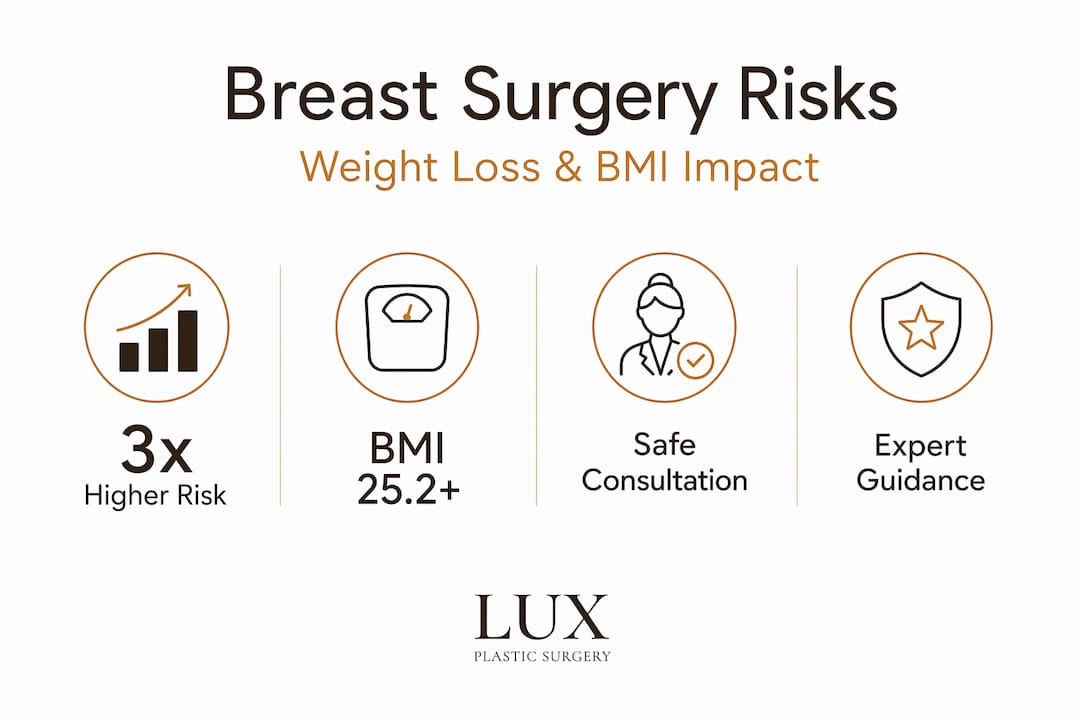
Patients with a BMI of 25.2 or above face more than three times the risk of complications within 30 days of breast augmentation compared to those below this threshold. Complications include wound healing problems, infection, haematoma (blood pooling), and the need for reoperation.
| BMI category | Complication risk | Key considerations |
|---|---|---|
| Below 25.2 | Baseline risk | Standard surgical planning |
| 25.2 to 30 | Elevated risk | Pre-surgical optimisation advised |
| Above 30 | Significantly elevated | Specialist assessment essential |
Preparing safely for breast surgery:
- Achieve and maintain a stable weight before consulting a surgeon.
- Stop smoking at least six weeks before surgery, as nicotine impairs wound healing significantly.
- Optimise nutrition, particularly protein intake, to support tissue repair.
- Disclose all medications and supplements, as some affect bleeding.
- Choose a surgeon who is fully registered with the General Medical Council and a member of BAAPS or BAPRAS.
The Royal College of Surgeons of England emphasises that plastic surgery must be performed by trained, regulated experts to ensure patient safety, particularly as procedures become more varied and patient profiles more complex.
Pro Tip: Ask your surgeon directly how many augmentation-mastopexy procedures they perform per year. Combined procedures carry a different technical demand than either operation alone, and experience with the specific combination matters enormously.
Reviewing the safe plastic surgery guidance UK page will help you ask the right questions at your initial consultation.
Practical advice for women considering breast restoration post weight loss
Good preparation separates a smooth recovery from a complicated one. The decisions you make in the months before surgery are as important as the operation itself.
Steps to take before booking surgery:
- Wait for genuine weight stability. Six months at your target weight is the minimum; longer is better if you are still fluctuating.
- Book consultations with at least two qualified surgeons to compare assessments and proposed plans.
- Bring reference photographs that illustrate your aesthetic goals, but remain open to what is achievable given your specific anatomy.
- Ask your surgeon to explain why they are recommending a particular procedure over alternatives.
- Request to see before-and-after photographs of patients with a similar starting point to your own.
- Understand the full recovery timeline. Most women need two weeks off work and six weeks away from strenuous exercise.
Practical preparations that improve outcomes:
- Wear a well-fitted supportive bra in the months before surgery to manage skin further settling.
- Incorporate chest-focused strength training to build underlying muscle tone.
- Review your weight and composition status with your GP if you have used weight-loss medication, as this can affect tissue quality.
- Maintain a balanced, protein-rich diet to optimise skin and tissue health.
- Arrange practical support at home for the first week of recovery.
Before committing to any procedure, it is worth evaluating plastic surgery options safely using a structured approach so your decision is fully informed.
Pro Tip: Do not underestimate the emotional preparation. Many women feel a mix of excitement and anxiety before surgery. Speaking with a counsellor or your GP beforehand is not unusual and often makes the recovery period more manageable.
Unique perspective: why treating volume and sagging separately matters
Here is something that often gets overlooked in online discussions about boobs after weight loss: volume loss and skin laxity are two entirely separate problems. They happen to occur together frequently, but they respond to different surgical solutions. Conflating them leads to poorly planned procedures and disappointed patients.
An implant placed into a breast with significant ptosis does not lift the nipple. It adds projection and fullness below where the nipple now sits, which can actually make the drooping more visible by drawing attention to it. Volume and ptosis are separate concerns; implants alone may not correct nipple position or excess skin, often necessitating a combined augmentation and lift for a natural, youthful result.
The error happens when patients focus on what they feel they have “lost” (size and fullness) without fully accounting for what the skin has done in response. A skilled surgeon does not simply replace volume. They assess the entire architecture: nipple position, skin envelope, chest width, shoulder breadth, and tissue quality. Only then does a coherent surgical plan emerge.
Combined procedures require significantly more surgical expertise than either operation performed alone. The lift element reshapes and tightens the skin envelope; the implant fills the newly shaped structure. If the two are not planned in concert, the result looks artificial or becomes asymmetrical over time.
This is why choosing a surgeon experienced specifically in breast augmentation and mastopexy combinations is not optional. It is the single factor most likely to determine whether your result looks natural or not.
How Lux Plastic Surgery supports your breast restoration journey
Breast changes after weight loss are deeply personal, and the surgical response needs to be equally so. At Lux Plastic Surgery, Professor Sandip Hindocha brings specialist expertise to every consultation, assessing your individual anatomy, skin quality, and aesthetic goals before recommending any procedure.

Whether you need breast augmentation surgery, a breast lift, or a combined procedure to address both volume and sagging, every treatment plan is built around your specific presentation. Modern techniques minimise visible scarring, and dedicated aftercare ensures your recovery is supported at every stage. If you are ready to explore your options with a surgeon who prioritises proportionate, natural-looking results, choosing the right clinic is the first step towards reclaiming confidence in your body.
FAQ
Do breasts always get smaller after weight loss?
Breasts usually shrink after weight loss but not always. The fat-to-glandular tissue ratio is the key variable, meaning some women see minimal size change but still experience sagging.
What surgical options exist to restore breast shape post weight loss?
Options include implants to restore volume, a mastopexy to remove excess skin and reposition the nipple, or a combined augmentation-mastopexy that addresses both concerns in a single procedure for the most natural outcome.
How does body weight affect breast surgery risk?
A BMI at or above 25.2 independently increases the risk of complications following breast augmentation by more than three times, making pre-surgical weight stabilisation an important safety priority.
When is the right time to consider breast surgery after weight loss?
Waiting six months of stable weight before surgery is the clinical benchmark, as it ensures your skin and tissue have settled and your results will be consistent and lasting.